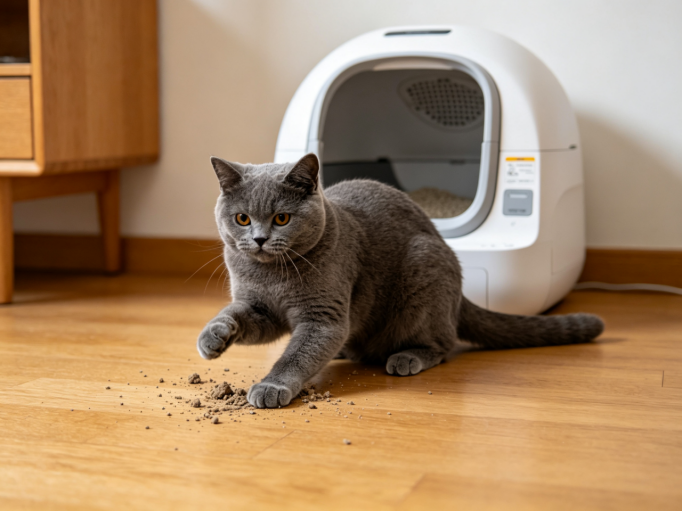

Every cat owner should recognize these warning signs.
Every cat owner has seen this scene: a cat pacing back and forth at the entrance of its litter box.
You may have spent a small fortune on a smart litter box, only to have your cat refuse to use it. It’s easy to assume the cat is just being picky — but that’s not what’s happening. Cats can’t talk, yet they show every ounce of their dissatisfaction through their behavior before and after using the box. Learning to read those signals will save you more hassle than replacing ten litter boxes ever would.
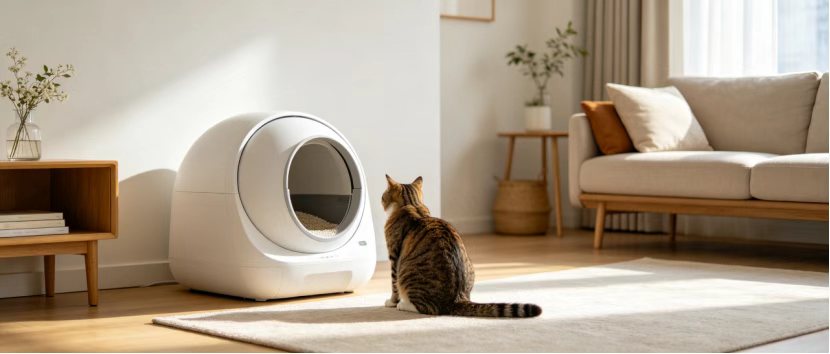
- Before the Box: The Rejection Starts at the Door
The cat sniffs around the box repeatedly, circles in place, and hesitates to go in. It paws at the entrance, scratches the empty box a couple of times, then stops. Some cats get close, sniff, turn around, and walk away — or even give the box a wide berth.
An even clearer sign is crouching beside the box, yowling, and scratching at its sides. That isn’t play. It’s the cat saying, “I don’t want to go in.”
Cats have an extremely sensitive sense of smell. Lingering odors at the entrance, the plastic smell of the machine itself, or the scent left behind from the last use can all make a cat immediately rule the box “unacceptable.” - During Use: Never at Ease Inside
Some cats stand instead of squatting, scratch the litter a couple of times, and dash out. Others squat awkwardly with their tails stiff, urinating on the edge or even outside the box.
The most telling pattern is the “in—out—in” routine. The moment the cat squats down, the sound, vibration, or sudden movement triggered by the machine’s sensors startles it, and it bolts right out.
Cats have excellent memories. After being startled once or twice, every trip to the litter box starts to feel like a threat, and the cat grows more and more reluctant to go in. - After the Box: A Bad Review in BehaviorA content cat carefully covers its waste. A dissatisfied one scratches the surface a couple of times and walks away — or skips burying altogether, then turns to scratch at the floor outside the box instead. That’s the cat pretending to bury its waste because it finds the box hard to use.
Scratching the floor outside the box is the cat “pretending to bury” its waste.
Some cats frantically shake their paws and lick their claws after leaving, as if they’ve stepped in something dirty.
The more serious protest is going elsewhere: the carpet, a corner, your bed — or simply peeing wherever it pleases. Cats are clean animals. If a cat no longer wants to leave its own scent in the box, the box has pushed it past its limit. - Why Cats Say No: Five Common Causes
The box isn’t cleaned promptly enough.
The cleaning cycle is too loud or vibrates too much, startling the cat.
The entrance is too high or too narrow to get in and out comfortably.
There isn’t enough litter to dig and bury in.
Plastic odors or cleaning-product residue linger. - What a Cat-Friendly Smart Litter Box Looks Like
A smart litter box that truly satisfies cats meets at least these four criteria:
Prompt, thorough cleaning. The cat walks away, and the box handles the rest — no lingering odor.
Quiet operation. Gentle, low-noise cleaning, ideally with a silent mode, so the cat is never startled.
A cat-friendly entrance. Height and width that work for multi-cat households, including heavy and senior cats.
Effective odor control. Odors are locked in immediately, so the cat never starts associating the box with an unpleasant smell.